
A PUBLICATION OF FRIENDS OF EL MORO ELFIN FOREST
P.O. BOX 6442, LOS OSOS, CALIFORNIA 93412-6442 ❖ (805) 528-0392 ❖ AUTUMN 2026
Join the Annual Celebration
on Saturday, September 26
We invite you to join the Friends of the El Moro Elfin Forest Annual Celebration on Saturday, September 26, from 11:30 a.m. to 2 p.m. at the Red Barn (2180 Palisades Ave.).
Biologist Cindy Roessler will introduce you to some of our local bees with up-close photographs, and she will describe the bumble bee surveys currently in their second year at the Elfin Forest.
Light refreshments will be served at 11:30 a.m.
with the presentation and general meeting from
noon to 2 p.m. Please try
to carpool, as parking is limited.
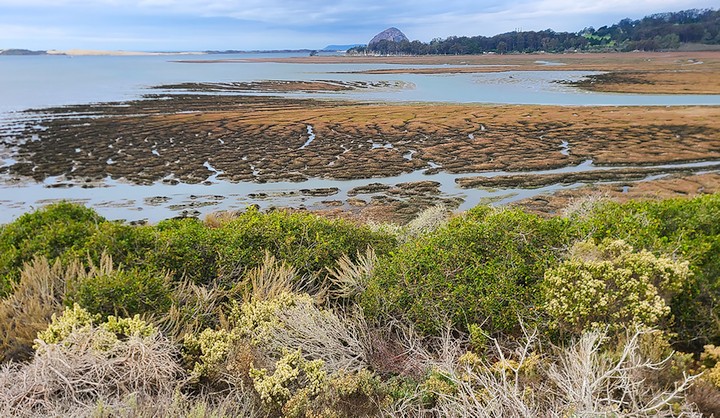
The Estuary at low tide.
Photo by Rebecca Rasmussen.
State of the Forest: Look Up
It's so easy to look down. Walking on the boardwalk, we often stay focused on our feet, on where our next steps should be. We aim our eyes downward, looking at the plants or small animals or the tracks they leave behind. It's true. I, too, often find myself with head tilted down, scanning the boardwalk and forest floor, looking for trash to pick up or other items that don't belong. It is only when I stop to take a breath that I take a moment to look up, and I realize how much I've been missing.
Sometimes, it takes my breath away, all that I have overlooked, or rather "underlooked": the thrasher perched at the top of a bush keeping watch, the bees collecting pollen from the oak catkins, the beautiful cloud formations and the stunning birds of prey soaring overhead. If I look farther, I can see Morro Rock or the mountains rising out of the earth, and my perspective grows.
Looking up, I can see the whole picture. How everything fits together. How the flow of the landscape meets the estuary. How the fresh water meets the salty. How the plants and trees arrange themselves in their habitats. To me it provides a sense of wholeness, of calm, being part of something bigger and more grand than just a singular life form. Every living thing makes contributions towards the whole. Together, we are part of an amazing place on an amazing planet in an amazing universe.
Throughout this issue of Oakleaves, we are
including quotes about looking up that we hope you
will enjoy. May they serve as a reminder for us to
take our time as we move through the forest and
reflect on the countless points of view that nature
has to offer.
"Look, up at the sky. There is a light,
a beauty up
there, that no shadow can touch."
— J. R. R. Tolkien, The Lord of the Rings
BOARD OF DIRECTORS
of the
Friends of El Moro Elfin Forest
(FEMEF)
Rebecca Rasmussen, Chair
Steve Hendricks, Vice Chair
Roger Carmody, Treasurer
Dave Bowlus, Secretary
Beverly Boyd, Acting Recording
Secretary
Hallie Cooks, Student Intern
Pat Brown
Ron Ruppert
The FEMEF Board of Directors
meets monthly. Meeting days and
times can vary and will be posted
on the home page at
www.elfin-forest.org
FEMEF Board meetings are virtual
and are open to the public. To
attend a FEMEF Board meeting,
leave a message at
(805) 528-0392.
CONTACT FEMEF
If you have questions about
FEMEF activities or want to
volunteer, please call
(805)528-0392
and leave a message. A recorded
message will give information about
our coming activities and other
events.
If you have questions, concerns, or
comments about any problems in
the Elfin Forest, call or write Kali
Beard, SLO County Parks
Supervising Ranger
1144 Monterey Street,
SLO, CA 93408
(805) 781-1196
Owners of dogs off-leash can be
cited. If you witness dogs off-leash,
vandalism, or obvious crimes, call
the County Sheriff
at
(805) 781-4550
or Kali Beard
at
(805) 781-1196.
If you see or smell smoke, call 911.
 @FriendsofElMoroElfinForest
 @el_moro_elfin_forest_
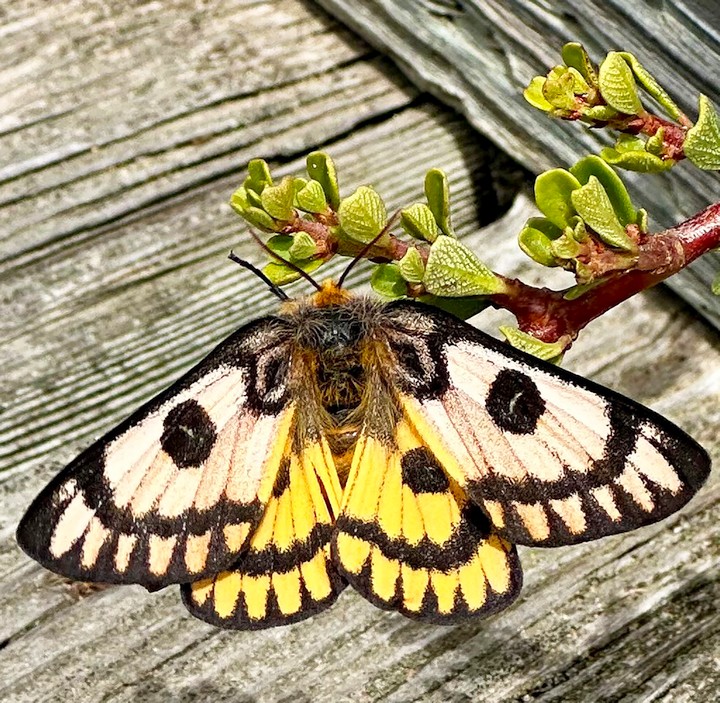
by a recent visitor to the Elfin Forest.
Photo by Joan Larive.
Join Us! First Saturday Work Parties
We invite you to join us on any first Saturday
from 9 a.m. to noon at the north end of 15th Street
in Los Osos to enjoy satisfying physical activity
in fresh air amid lovely surroundings.
Please dress for wind, fog, or sun and in layers
including long pants, long shirt sleeves, work
gloves, and sturdy shoes with closed toes.
For more information, call (805) 528-0392.
"The plants look up to heaven, from whence they
have their nourishment."
— William Shakespeare
Pericles
**Nature is wonderfully unpredictable.**
Information in this newsletter is
provided for educational purposes.
Because wild ecosystems are complex
and dynamic,
specific observations
may occasionally differ from standard
scientific reporting.
Weasels in the Elfin Forest
A recent sighting serves as a reminder that some of the Elfin Forest's most fascinating residents are also the easiest to overlook. "I just saw a weasel chasing the bunnies at the little bench area on the way to Sienna's View," one local visitor reported. "I had forgotten about weasels being in the Elfin Forest." An additional sighting was reported on iNaturalist in October 2020.
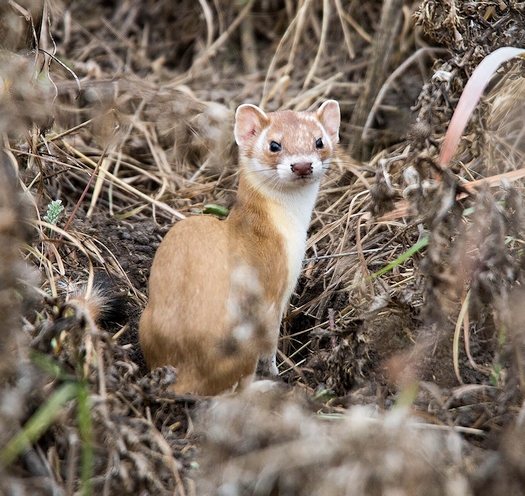
Elusive, quick, and rarely seen, the long-tailed weasel (Neogale frenata) is a small but formidable predator quietly playing an important role in the local ecosystem.
Primarily nocturnal, long-tailed weasels are highly efficient hunters that help balance rodent populations. In habitats like the Elfin Forest, they are often found in coastal scrub and may take shelter in abandoned burrows.
Measuring roughly 12-15 inches in length, these slender Weasels in the Elfin Forest mammals have a rich brown coat that remains consistent throughout the year in coastal California. In colder regions, however, long-tailed weasels undergo a seasonal transformation, turning white in winter, known as the ermine phase.
According to NatureWorks, most of their diet consists of small mammals such as mice, voles, rabbits,
gophers, and chipmunks, though they will occasionally eat birds and insects. In the wild, they typically live 5-7 years.
NatureWorks also notes that long-tailed weasels are highly vocal, using a range of squeals, squeaks, trills, and purrs,
and can be surprisingly aggressive when defending their territory.
Taxonomy
The long-tailed weasel was historically classified in the genus Mustela (Mustela frenata), but in 2021,
researcher Bruce Patterson reclassified it into the genus Neogale, reflecting updated scientific understanding
published in the Journal of Animal Diversity.
Folklore
Beyond biology, weasels have long captured the human imagination. A Scottish tale describes what appears to be a kind of "weasel funeral," in which multiple weasels were observed carrying and burying a fallen companion, an account echoed by similar stories dating back nearly a century. While such stories are difficult to verify, they add an air of mystery to an already elusive animal.
While sightings like these may feel rare, the long-tailed weasel has likely been a steady, unseen presence in the Elfin Forest all along. The next time you walk the trails, you may not spot one, but knowing they're there adds another layer of intrigue to the forest.
Please Report Sightings
Have you observed any unusual plants or animals in the Elfin Forest? Taken a good photo? Please report any interesting sighting to your Oakleaves editors at:oakleaf@elfin-forest.org
Bat Walk Reveals Nightlife of the Elfin Forest
Retired biology instructor Ron Ruppert led participants on an evening walk that documented five bat
species, and he's asking the community to help track local bat populations by reporting sightings. Ron
shared many fascinating insights into the habits and mysteries of these elusive flying mammals.
Using the Echo Meter Touch 2 with a Samsung (Android) tablet, Ron confirmed the presence of five
different species of bats:
Hoary Bat (Lasiurus cinereus)
- This was the first bat
recorded but I did not discover that until
analyzing the Echo Meter this morning. This is a large bat in our area. They are often solitary when
roosting where they hang our under tree bark and on tree branches where they blend in by looking like
leaves. They have broad wings allowing them to maneuver while chasing their prey. This is the ONLY land
mammal found on the Hawaiian Islands.
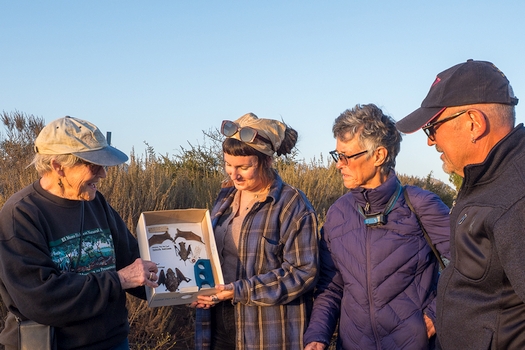
box at the recent Bat Walk.
Photo by Pat Brown.
Mexican Free-Tailed Bat (Tadarida brasiliensis)
- I also missed this one early on but it showed up on
the recorder. They have the mouse like tail that is not
connected to the tail membrane thus "free." They
form large colonies in caverns and under bridges such
as the Yolo Bridge near Sacramento. They are the
fastest bats in level flight and may be the fastest
mammals recorded at nearly 100 mph! They are
known to devour 25-50% of their body weight within
a nightly 30 minute foraging flight.
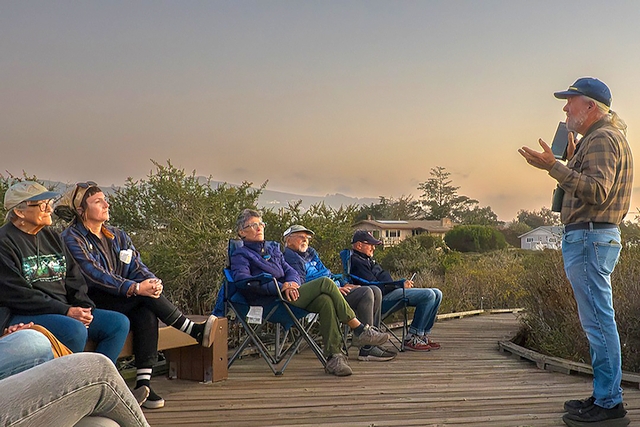
at the recent Bat Walk.
Photo by Pat Brown.
Big Brown Bat (Eptesicus fuscus)
- A common
bat in our area, hanging out in small colonies
wherever they can find a crevice. Often found in and
around human structures. These are the second or
third largest bat in California. On this night this was
the most common bat we recorded.
Pallid Bat (Antrozous pallidus)
- The California
State bat! A medium sized bat in
our area. Can forage on the
ground often eating Jerusalem
crickets (potato bugs) and
leaving the head and legs of the
insect scattered below the
roosting spot.
Silver-Haired Bat(Lasionycteris noctivagans)
-
Recorded twice on our evening
outing. They are large like the
Hoary Bat and have some of the
same behaviors.
If you have found bats (dead or alive) in SLO county, Ron would like to know about your sightings. Take a picture if you can and send it to oakleaf@elfinforest. org.
Editing by Liana Harlan; editing assistance by Bob Dees; fact checking by Jeff Reifel; finish editing by Faylla Chapman; photo editing by Cheyenne Winn Layout by Rebecca Rasmussen Printing by Hay Printing Contributers to this issue: Pat Brown, Suzette Girouard, Liana Harlan, Vicky Johnsen, Betsy Kinter, Joan Larive, John Nowak, Rebecca Rasmussen, Bonnie Walters (in memoriam), Dirk Walters, Jean Wheeler. Deadline for copy to Oakleaves is the first of the month before issue. If possible, all copy should be submitted by e-mail to
oakleaf@elfin-forest.org.
Common, Bush or Sticky Monkey Flower
Drawing by Bonnie Walters
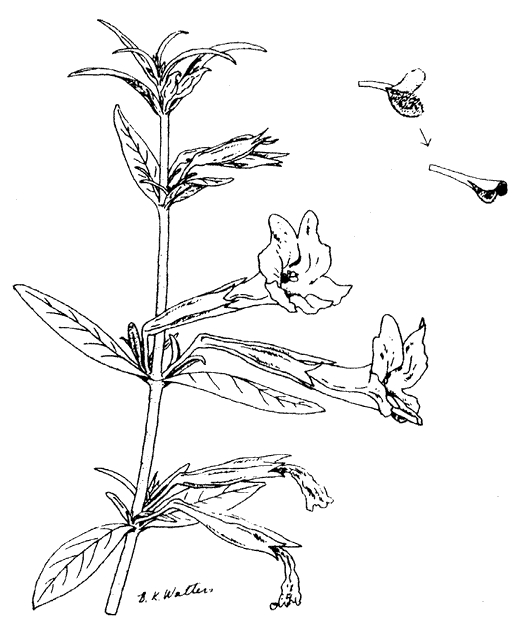
As I write this (late February), I anticipate the orange or golden tubes of the bush monkey flower to be one of the most common and obvious flowering shrub all along our immediate Pacific coast. It's one of the most common shrubs throughout the California Floristic Province, which extends from southern Oregon to northern Baja, Mexico, and west of the crest of the Cascade, Sierra, and Peninsular Ranges. In this county, at least four more or less recognizable types are known. The one around the San Luis Obispo, Morro Bay and Arroyo Grande areas has the flowers are borne on long stalks (pedicels), have shorter tubes, and are orange in color (Mimulus (and/or Diplacus) aurantiacus). This is form that Bonnie has drawn. I suspect it would make a great addition to any garden as it tolerant of a wide range of exposure, moisture, and soil type.
Common names include common sticky, or bush monkey flower. Monkey flower comes from the observation that one can recognize the face of a (laughing) monkey in the spot pattern of the fused petals (corolla). I have to admit, since coming to California, I have often looked for this face and have yet to see it in any of the species I have observed. In a search of the internet I found that others have had the same problem. One author even indicated that over active imaginations may be the source of the name. The adjectives, common, bush, and sticky are all appropriate as they are all descriptive of this monkey flower. First, it is the most common and widespread monkey flower in our area and the only one visible from the Boardwalk in the Elfin Forest. Bush refers to the fact that it is tall (up to 3 feet or 1 meter) somewhat woody, i.e. it is a shrub or bush. "Sticky" refers to the trichomes (hairs) that cover the leaves. They have a bulbous tip that breaks down into a sticky goo.
The scientific name does offer some confusion. The specific epithet (second name or aurantiacus) is generally no problem especially for the plants that grow here on the coast and in Elfin Forest. The name "aurantiacus" is derived from New Latin and means the color orange, which is the color of the corolla in our plants. But this species of monkey flower is extremely variable and changes color in different areas of it range. For example it's mostly yellow in our county in the Santa Lucia Mountains and eastward. The genus name is a bit more confusing. Is it Diplacus or Mimulus? I decided to do a little literature search on the Internet. It turns out there is not really scientific consensus on this question. Maybe a little history would be helpful.
When I came to California in 1969 the main flora in use at the time was, Munz and Keck, A California Flora. They placed all of the California monkey flowers into the single genus, Mimulus. Dr. Hoover, in his 1973, The Vascular Plants of San Luis Obispo County, California, placed the Monkey flowers in two genera depending on whether they were woody or not. The woody ones he placed in Diplacus and the herbaceous ones in Mimulus. The current botanical bible, The Jepson Manual places all the monkey flowers in the single genus Mimulus. So we should be able to say, "Case closed!"
It is now time for DNA to confuse the story. But before I go there, I need to also note that this genus has switched botanical families. In the older references, monkey flowers were in the very large and diverse figwort family (Scrophulariaceae). General consensus now places the monkey flowers in the family, Phrymaceae. This family has a worldwide distribution, but most of its genera are native to the Southern Hemisphere. North America has only couple of genera in the family.
California, however, has most of the species and they are ALL monkey flowers. The basis for this family switch is primarily DNA based sequence comparisons. While they were getting the data to justify the family switch they also discovered sequence inconsistencies within the genera as well as between them. One of these inconsistencies apparently led to the breakup of genus Mimulus and/or Diplacus. Chloroplast DNA sequences indicated that Mimulus/Diplacus needed to be broken up into several genera. Most of the species (both herbaceous and woody) ended up in the genus Diplacus and that is where our species ended up. Mimulus, according to this research, is reduced to seven species in North America with only two in California. The rest go to Diplacus based primarily on flower features and DNA sequence data. So our monkey flowers seem to be Diplacus aurantiacus at least for now. I noted a problem when I read the paper. It seems that DNA from chloroplasts indicates one relationship while that from the Nuclear DNA indicates another.
When you go out to look for the flowers of the shrubby monkey flower, you may want to see it move. Most people know plants can move their leaves in response changing light conditions and seeds and pollen move if wind, water or animals carry them. However, these types of movements are often so slow that most of us will never have actually seen them. Some of us, who are nature TV junkies, may have seen plant movements in time lapse photography. In plants of this genus, the stigma (the end of the central bowling pin shaped structure, called the pistil or female organ,) consists of two small flat plates. When the flower opens, the plates are spread apart exposing the lower part of the upper plate and the upper side of the lower plate. These two surfaces are the pollen receptive portions of the stigma. When pollen is deposited on one of these surfaces, the two plates move together relatively rapidly or 'slam' shut. This relatively rapid movement can be seen anytime, by simulating a successful pollination. Just, gently rub the stigmas with a pine needle, pencil point, or grass leaf and watch the stigmas close. If you came back to the same flower after a few hours, the stigmas will have reopened, so no permanent damage will have been done.
Conservation Report
May 2
Eleven volunteers worked about 2 hours each at various tasks. Dave Bowlus removed a rotting wooden bench from Bush Lupin overlook. Natalie and Julia tackled the remaining Veldt Grasses along the path from 15th to 16th. Zarah and her mom dug up Narrow Leaf Ice Plant in various locations. Pat Brown pulled down and dug up Asparagus Vine in an area that's been infested in the past. James Solum, Mason Price, a new volunteer Shy Gardner and I trimmed the entrance to and all along the 11th Street sand trail. That left Thad Geer to battle the: "Freeway Ice Plant" that's encroaching into the Forest off 14th Street.
The Veldt Grasses, the Asparagus Vine, and all
trail trimmings were jammed into over a dozen 30+
gallon "Contractor" bags. This
was the first time we tried hauling away the trimmings.
Chopping up chaparral bushes into semi-manageable
pieces, filling the bags and dragging or rolling it all out
of the Forest took a huge amount of time and energy.
But THEN: we were left with the problem of how to
dispose of it all. Many volunteered to take bags to their
individual green waste bins. I know I hauled three. In
the end, we had to leave four very full and heavy bags
on the side of the 11th Street parking area. I asked Kali
and she kindly sent out someone from County Parks to
take them to the maintenance yard for Co. Parks for
disposal. (Later I retrieved the bags to patch and reuse).
This seems to be a less-than-desirable solution
to the challenge of disposing of trail trimmings.
My thanks goes to Steve and to Dean for
emailing me their thoughts on this topic last month.
June 6
Eleven volunteers arrived ready to tackle multiple chores. Jeff Reifel and Keith Gardner took on the chore of removing encroaching "freeway ice plant" out of the Elfin Forest just beyond 14th Street parking area. This was met with resistance from one of the homeowners until another neighbor helped Jeff work out a solution that everyone could agree on. Dean Thompson trimmed areas along the lower boardwalk while Dave Bowlus repaired and painted those wooden benches which were in the worst shape. Pat Brown, Natalie Zaragoza, Angela Logan, Julia Ferguson,
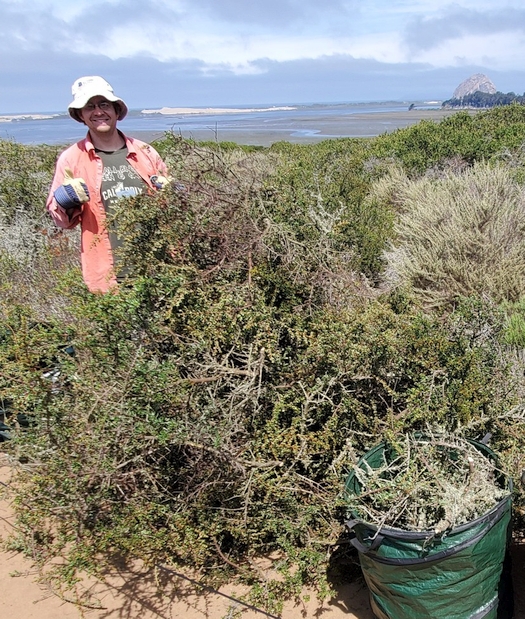
trimming the upper boardwalk.
Photo by Dean Thompson.
Shy Gardner, and James Solum joined
me in pruning vegetation along various trails. This
generated a huge amount of brush trimmings.
Shy and Keith Gardner managed
to dispose of almost half. My heartfelt thanks goes out
to them. The remaining pile of trimmed branches
formed a big mound which was left on a tarp on the
side of the "paper road" between 11th and 12th street
parking areas. Unfortunately, SLO County Parks did
not have the trucks nor the staff available to come pick
up as they did the previous month. I scrambled and
enlisted the help of Natalie Zaragoza as well as my
neighbor, Murray Kirby (as both had pickup trucks)
and on Thursday, June 11th, we managed to fill up the
back of both trucks for the drive out to the County
Park's maintenance yard. With head ranger, Kali
Beard's permission, the vegetation was left alongside
their chipping machine ready for later mulching.
July 4
Nine volunteers showed up for our: "First- Saturday-Work-Day" on July 4th, despite it being a holiday. Five volunteers worked diligently to rid the slope below "Butterfly Hill" of the Narrow Leaf Ice Plant infestation that we've battled repeatedly in the past. Dean Thompson and James Solum trimmed the Upper Boardwalk of the encroaching Ceanothus. Jeff Reifel removed much of the barbed wire that was discarded below Bush Lupine Point. Zarah Wyly surveyed the interior of the Forest for areas in need of attention as far as invasive plant removal.
Care of Elfin Forest Endemics in Your Garden
As fall approaches, it's time to prepare our gardens for the winter. Fall is also the ideal season to plant Elfin Forest favorites such as black sage (Salvia mellifera), buck brush (Ceanothus cuneatus), Morro manzanita (Arctostaphylos morroensis), and many others.
How do we prepare our gardens for winter?
Here are some steps we have developed over time. First, we like to walk through the garden and look closely at each area. Do some of these areas have old plants that need to be replaced? We sometimes take a note pad with us to write down our thoughts. Sometimes we like to do this after work, when we're feeling relaxed. If we are designing a garden plan, we ask ourselves, "What would grow here that I see on my nature walks?" This could take weeks, but knowing that the rains are coming can be encouraging. When possible, we try to match size to area. For example, a Ceanothus plant or a manzanita in a large sandy area along with Salvia mellifera would be appropriate.
We can't have fun all the time, so our next step is weeding. We prefer hand pulling, following up with mulch. When possible, use oak tree chippings as a soil top dressing to discourage weeds. In my experience, when mulch is applied too thin, it is ineffective. A thick layer of three inches will inhibit or kill most annual weeds. Perennials such as veldt grass will not be controlled with mulch. You must first remove established clumps of veldt grass by hand and then follow up with mulch to kill the seeds.
With warmer fall nights comes the need to keep
a keen eye out for insect pests. Many pests will show up
when you least expect them. Spider mites and aphids
attack manzanitas (Arctostaphylos species), Ceanothus
species, pacific wax myrtle (Myrica californica) and coast
live oak (Quercus agrifolia). Luckily, we have a secret
weapon—water. Using a spray nozzle, turn the
operating dial to "jet" and rinse insects off an infected
plant. You can safely control insect populations with a
once-weekly early morning
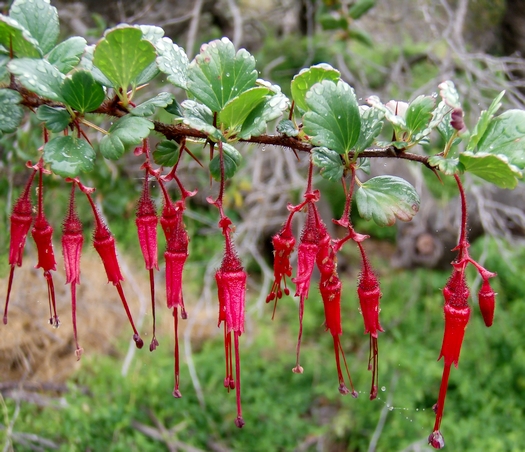
Photo by Pat Brown.
spray. For severe infestations, an application of neem oil or insecticidal
soap followed weekly with a spray of water will rid your
plants of most soft-bodied insects such as spider mites
or aphids.such as those sold under the Bonide name brand.
For hard-to-control insects such as scale, thrips,
and mealy bugs, you might use a horticultural oil spray,
Usually, when you have scale or aphids, ants will follow,
using the other insects as a food source, with their
honey dew being a favorite treat. To control ant
colonies, use ant bait stations or ant bait stakes
(cautiously around pets and wildlife). Whenever you
spray in the garden, even with a totally organic
product, watch out for bees. If you see bees, the rule is
to not to spray. Spray late in the day when bees have
returned to their hives. When using only water, lightly
spray first to send the bees on their way. Then increase
the water stream using top-to-bottom motions to wash
the plants.
We will conclude with a few steps for pruning. Many Elfin Forest species, when grown in the garden over time, will require pruning. Remove overgrowth, dead flower heads, and insect infested branches, or give an overgrown plant a general shaping. After pruning, water heavily to remove dirt and grime to give the plant a fresh appearance. Now you are ready for selecting your favorite Elfin Forest plant for your garden. We have chosen the fuchsia-flowered gooseberry (Ribes speciosum) to plant in our garden.
Coming Up in the Elfin Forest
Autumn in our Elfin Forest remains colorful. Flowers on some species are changing as they age, often maturing into vibrant berries or seed heads. Birdlife continues to provide flitting streaks of color. Young hatched in spring are now maturing and feeding themselves. Some avian migrants will pause here on journeys southward. Others settle here for our mild winter, returning north to warming nesting regions in spring.
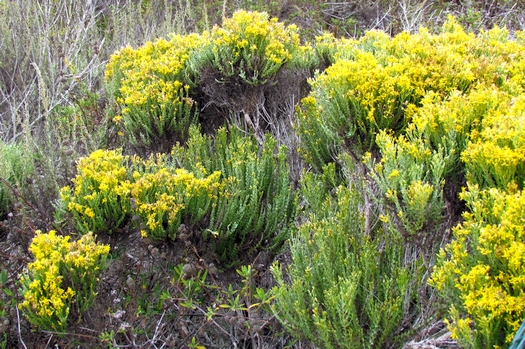
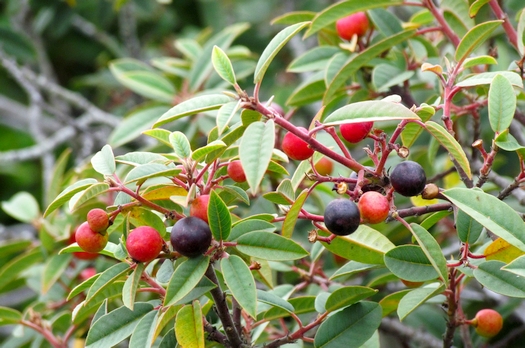
Yellow mock heather flowers (pictured) bloom from August into September. White dune buckwheat flowers age to pink, then rust. Honoring Halloween, the white flowers of black sage become robust black seed heads. Near the estuary, large bushes now carry the coffeeberries for which they are named (pictured), aging from yellow, through red, to black. Other flowers in autumn are California asters (white to pinkish or lavender petals around yellow central disks), seaside golden yarrow, coyote brush (fluffy white flowers), and dune buckwheat bush (white flowers of summer have aged to dark pink or rust). Birders in autumn will be looking for migrating species as well as our resident species. With climatic warming in recent decades, we miss seeing our estuary almost carpeted with huge flocks of migrating birds. However, there will still be at least some birds in those migrant species arriving to spend winters with us, or pausing in passing through during their migrations to Central or South America. They seek warmer weather and much better food supplies than their nesting areas can provide in northern winters.
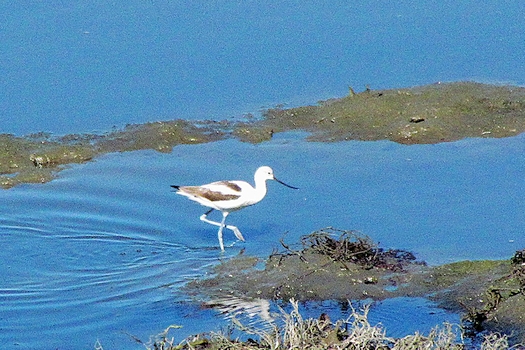
Resident and migrant dabbling ducks to look for include mallards, northern pintails, gadwalls, American wigeons, northern shovelers, blue-winged teal, cinnamon teal, and green-winged teal. Diving ducks could include ringnecked, canvasback, bufflehead, common goldeneye, red-breasted merganser, and ruddy ducks. Horned, eared, piedbilled, western, and Clark's grebes also may be seen until March or April. Shorebirds such as sandpipers, dowitchers, and the American avocet (pictured) reach peak populations by the end of autumn.
Of course, we continue to have many resident
birds in our Elfin Forest, such as California scrub
jays, California quail, spotted towhees, and bushtits.
We also host brush or woodland birds migrating
through or wintering. Fox, Lincoln's, and goldencrowned
sparrows join our resident
white-crowned
sparrows, and Say's phoebe joins the black phoebe. Some American robins, hermit thrushes, cedar
waxwings, western tanagers, and pine siskins may
also visit.
We may not have tall trees covered in big red, orange, and yellow leaves in our autumn, but we do have lots of colorful flowers, fruits, and very active and beautiful birds, and even brush rabbits, squirrels, lizards, and very occasionally a coyote or deer may be seen from or even on our boardwalk!
"It's all a great mystery...
Look up at the sky and
you'll see how everything changes."
—Antoine
de Saint-Exupery
The Little Prince
WALKS in the ELFIN FOREST
Docent-Led Third Saturday Walks
Reservations required.
To reserve a spot on the
walk, email us at walks@elfin.forest.org and
indicate the number in your party in the subject
line of your email.
* September 19, 9:30 a.m. - Learn about
Oaks and Acorns with Zarah Wyly
* October 17, 9:30am - Learn about the 9
Sisters, Salt Marsh, and Bay with Faylla
Chapman
* November 21, 9:30am - Explore Potions and Poisons
with Jeff Reifel and Barb Renshaw.
Walks begin at
times stated above at the north end (1100 block) of 15th
Street off Santa Ysabel in Los Osos. Wear closed-toe
shoes, long sleeves and pants to avoid poison oak and
mosquitoes. Park carefully, avoiding driveways and
mailboxes, and leave pets at home. The easy-paced walks
last 1-1/2 to 2 hours.
For more information or if you use a wheelchair, call
(805) 528-0392.
Photo by Cheyenne Winn.
Photo by Jeff Reifel
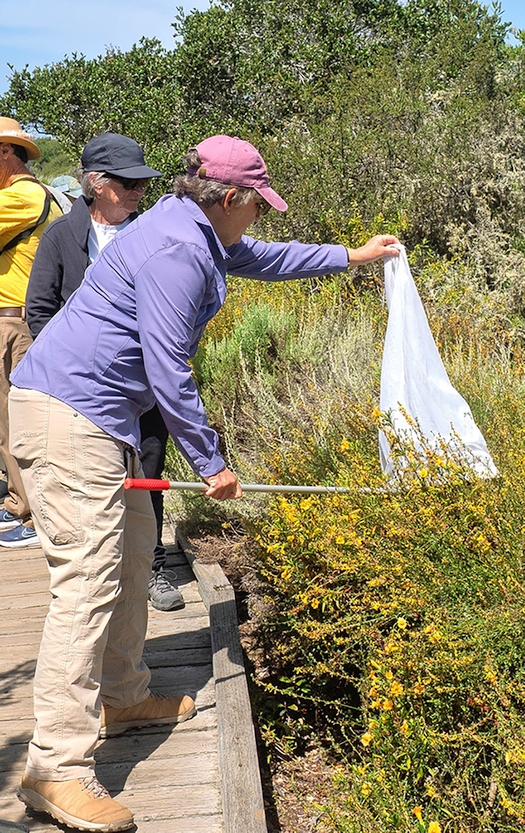
Photo by Pat Brown.
"Stars don't beg the world for attention;
their beauty
forces us to look up."
—Matshona Dhliwayo
Canadian-based
philosopher, entrepreneur, and author of books
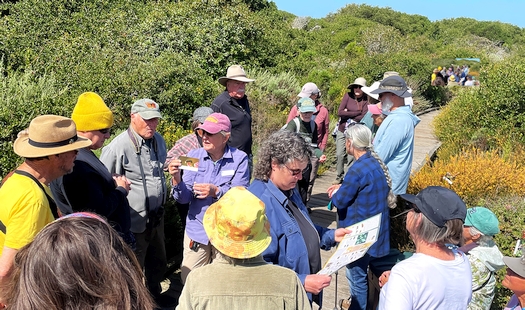
Photo by Jeff Reifel.
Thank You to Our Generous Members
FEMEF Database Coordinator
NEW LIFETIME MEMBER
Katy Budge
NEW MEMBERS
Phoebe Adams Lara Bertaina*
Sally Ames*
RENEWING MEMBERS
L.R. Erickson* Cindy Roessler*
Kevin & Julia Ferguson *Bertram Townsend*
Sarah L. Hooper* the Ungar family*
Margaret Lange Janice Verity*
Tim & Melissa Rochte* Edward & Marilynn Vilas*
DONATIONS
Sarah Berger Dennis Sheridan
Andrea Davis Kenneth Stoddard
Paolo Perrone
If you recently sent a donation to FEMEF and don't see your name in this issue's New and Renewing list, be assured that your gift will be acknowledged in the next quarterly issue. Gifts are processed by two different volunteers before reaching our editors, and newsletter copy deadline is one month before the date of issue.
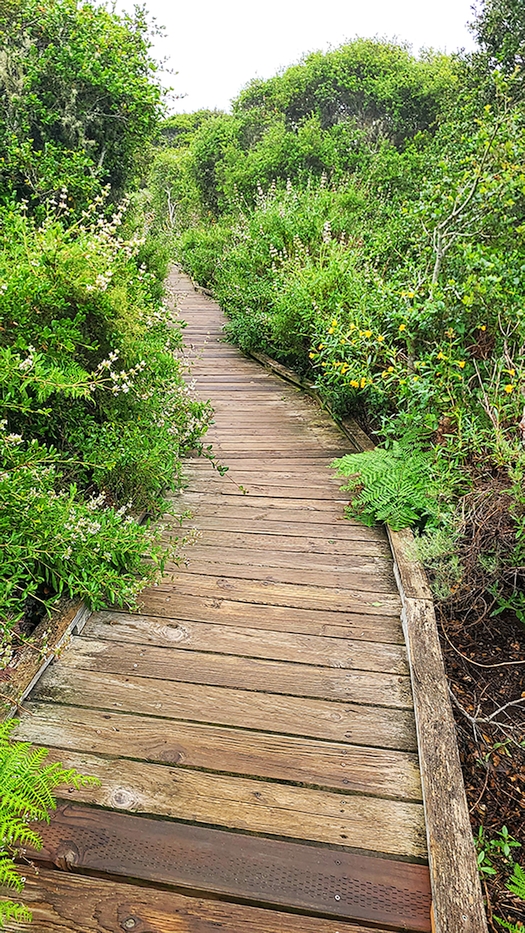
Photo by Rebecca Rasmussen.
"When you look up at the sky, you have a
feeling of unity which delights you and
makes you giddy."
— Ferdinand Hodler, Swiss painter
Share Your Observations with

Did you know you can use the iNaturalist
app to share your observations in the forest?
Anyone can upload photos and identify species they
have seen in the forest. You can also search and
view what others have reported in the area.
At its core, iNaturalist is about people
helping each other identify and learn about the
organisms they observe. The iNaturalist app works
on all devices.
inaturalist.org/places/el-moro-elfin-forest
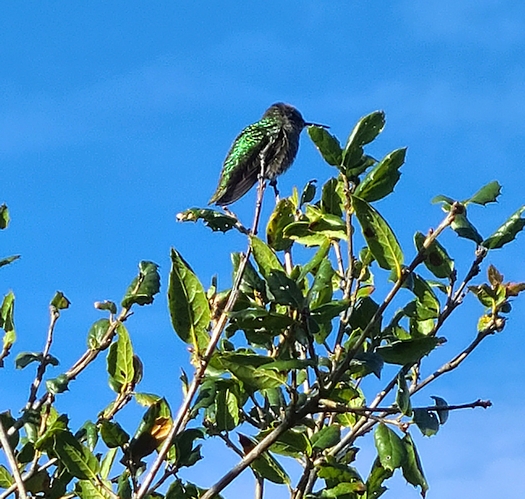
"If I really wanted to pray I'll tell you what I'd
do. I'd go out into a great big field all alone or in
the deep, deep woods and I'd look up into the
sky-up-up-up-into that lovely blue sky
that looks as if there was no end to its blueness.
And then I'd just feel a prayer."
— L.
M. Montgomery,
Anne of Green Gables
See Something, Say Something
Please report any illegal campers or other unlawful activity that you see in the Forest to the San Luis Obispo County Sheriff's Office-Coast Station located on 2099 10th Street in Los Osos. Their phone number is (805) 528-6083. A large fire in the Elfin Forest could spread to houses adjacent to the Forest. Lighting fires is arson, punishable with a jail sentence. In the event of a fire found in the Forest, call 911 for immediate assistance. The town of Los Osos receives emergency services through CalFire at Station 15-South Bay. They are located at 2315 Bayview Heights Drive in Los Osos. Their phone number is (805) 528-1053.
Call for Volunteers
This work continues to be done by a group of people with diverse talents. We have carpenters, webmasters, public speakers, photographers, fine artists, accountants, teachers, scientists, historians, filmmakers, writers, and more. But we still need help. What talent or skill do you have that could be added to the list? We invite you to join us as we continue the legacy. To volunteer to protect the Elfin Forest please call (805) 528-0392 or info@elfin.forest.org
FEMEF STORE
Online Purchases
Printable Order Form
MURAL SHIRTS & SWEAT SHIRTS
Mural design by artist Barbara Rosenthal
on both front and back.
Forest green fabric with the words
"Friends of El Moro Elfin Forest"
above mural and
"Los Osos, California"
below mural.
Indicate the desired size(s)
(S, M, L, XL, XXL, XXXL)

Short Sleeve T-Shirt $25

Long Sleeve T-Shirt $30

Pullover Hoodie $40
Zip Hoodie $45
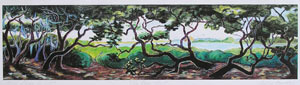
Signed prints by artist
Barbara Rosenthal,
image size 4 1/2 x 16 1/2
in:
Mounted on foamcore

15- ounce beverage mug with wrap-around mural design.
Microwave safe, hand wash suggested.

Elfin Forest Cap $20
One size fits all caps with adjustable straps in back,
100% cotton. Three colors—forest green, maroon, and navy.
Friends of El Moro Elfin Forest
P.O. Box 6442
Los Osos, CA 93412


